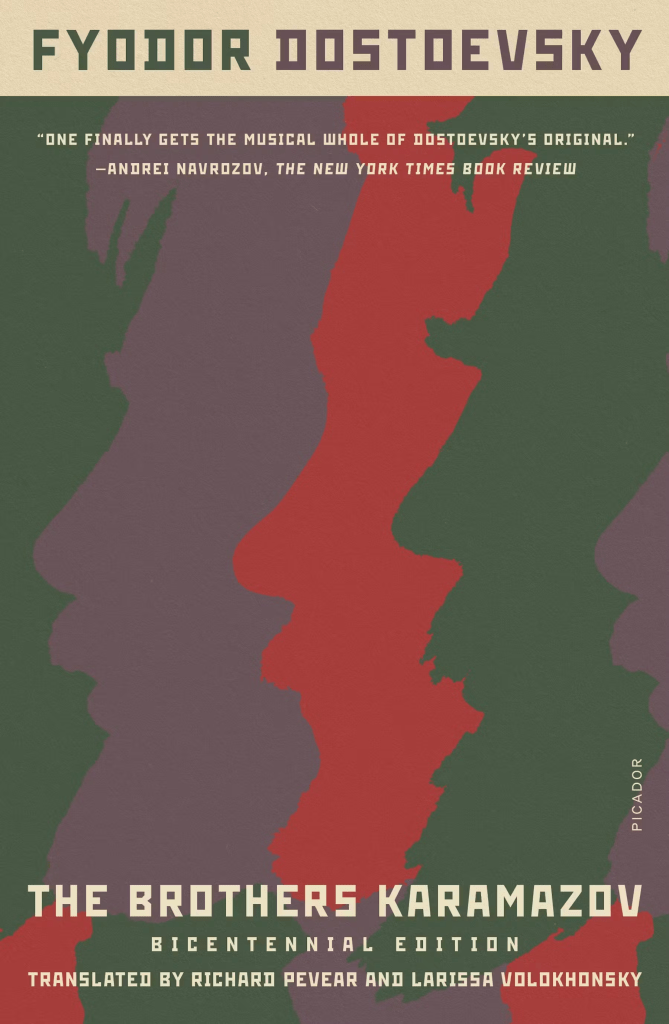
There’s not much I can say about this book that hasn’t already been said a hundred times before. I finished The Brother’s Karamazov after a month of picking it up and putting it down repeatedly for a number of reasons. But I was determined to finish it because it’s the perfect time of year for heavy classic Russian literature.
I ask myself “What is hell?” And I answer thus: “The suffering of being no longer able to love.”
I loved every moment of this book. Dostoevsky is a master of his craft. From the depths he gives each character and situation, to the huge questions he beckons you to wrestle with, to the allegory of nearly every plot point, everything is deliberate, sprawling, and it reads so naturally.
It’s clear that the actual story is just a conduit for most of the philosophy that Dostoevsky explores: morally broken characters wrapped in a heinous event, each one coming to terms with their responsibility in that event, and the levels of despair each character falls largely determined by the lens they are all meant to be as a position in the broader discussion.
I say ‘discussion’ in the singular, but this book tackles so many themes: greed, lust, murder, and justice, to name a few. Still, the central question is whether humanity can be good without faith. The ‘Grand Inquisitor’ is often called the book’s most significant moment, and I agree. The takeaway is that without a basis in faith, we lose the ability to calibrate our morality. If there is no God, then ‘everything is permitted’ because the very definition of ‘good’ disappears.
However, I am more inclined to cite the discussion between Ivan Fyodorovich and Lucifer later in the novel as my personal standout. Lucifer argues that Ivan’s nihilism is self-defeating because, without evil, there can be no definition of good. Without giving ‘the good’ a tangible representation, we find ourselves at odds with our innate consciousness—which I define here as our epistemic intuition that good exists and must be defined through our pursuit of it.
“…What good is faith by force? Besides, proofs are no help to faith, especially material proofs. Thomas believed not because he saw the risen Christ but because he wanted to believe even before that.”
The need to reconcile what we know to be good and its existence, Dostoevsky argues, relies on a spiritual underpinning that we aren’t really required to reconcile. We have a natural desire to be good, we try to be good, we aren’t always good, but in the pursuit of the good we create the beauty necessary for an otherwise ugly world.
 Signal Intent