Signal Intent

  • [sign on] January 8 2026

    The turn of a new year always brings a tinge of hope with it. Historically I have found a kind of new motivation whenever this hope manifests itself. This was by no means my quietest New Year’s Eve: I had a short celebration with some extended family, put the baby to bed, had some tea while I read a book, and kissed my wife when the ball dropped. It was perfect.

    But I didn’t feel the need to try and reinvent any certain aspect of my life. To be completely honest, this is comforting to me. I’ve never had a new year where I didn’t have a resolution and I’m taking this as a sign of personal growth. Being content with who you are and where you are in life is something many of us put an enormous amount of time, effort and money into realizing. I am not immune. Now I’ve come to this point and I am happy to be here; although a part of me knows this feeling is fleeting.

    In 2025 I read seventeen books. While I’m not setting a “number-of-books-read” goal this year, I am setting a goal of intentionality. The trend perpetuated by apps like Goodreads or Fable of “reading goals” has, at times, driven me to simply get pages behind me as opposed to getting ideas burned into my memory. To that end, I’ve begun annotating books more; a practice I started late last year during my read-through of Karamazov. I’m finding that marking passages, ideas, and lines that stand out to me as I’m reading with tabs and writing in the marginalia of pages my initial thoughts force me to come back to them when I’m sitting with a book once completed.

    However, the real magic happens when I sit with a book after I’ve completed it. I’m trying to purposely not read other reviews or user thoughts online so that I can try and pull my own themes out of each book, wrestle with them on paper, and come out the other side with a coherent grasp of each piece. This has been the most impactful change to my reading I’ve made since November, and is something I intend to continue. Some of that might end up here, some won’t; you’re welcome to follow along.

    Currently reading: My Struggle (Book 1) – Karl Ove Knausgaard

    Currently listening:

    Happy New Year!
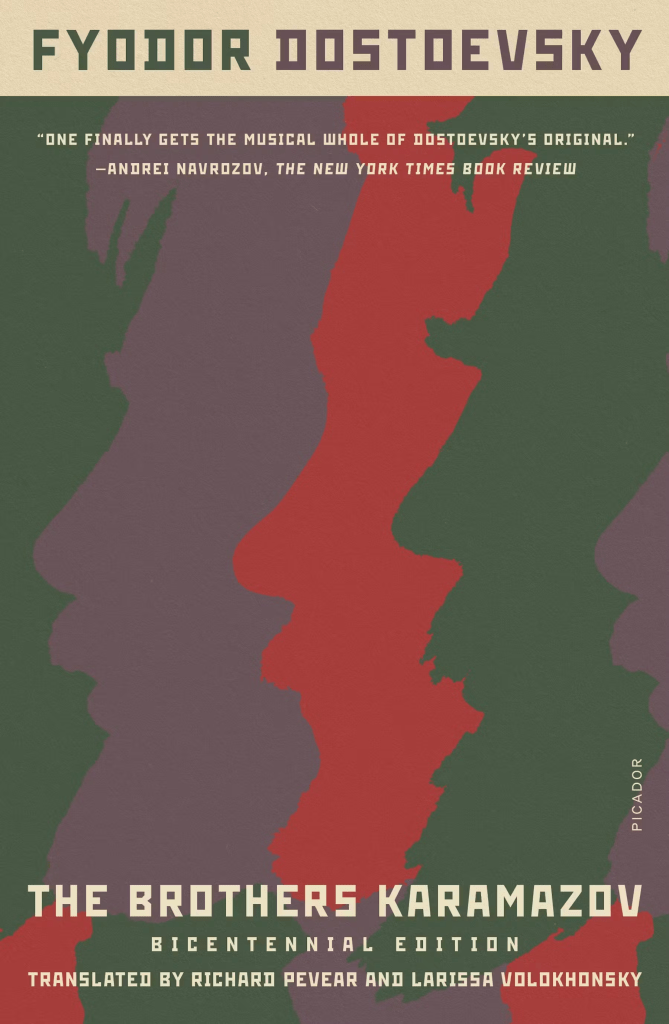
  • The Brother’s Karamazov by Fyodor Dostoevsky

    There’s not much I can say about this book that hasn’t already been said a hundred times before. I finished The Brother’s Karamazov after a month of picking it up and putting it down repeatedly for a number of reasons. But I was determined to finish it because it’s the perfect time of year for heavy classic Russian literature.

    I ask myself “What is hell?” And I answer thus: “The suffering of being no longer able to love.”

    I loved every moment of this book. Dostoevsky is a master of his craft. From the depths he gives each character and situation, to the huge questions he beckons you to wrestle with, to the allegory of nearly every plot point, everything is deliberate, sprawling, and it reads so naturally.

    It’s clear that the actual story is just a conduit for most of the philosophy that Dostoevsky explores: morally broken characters wrapped in a heinous event, each one coming to terms with their responsibility in that event, and the levels of despair each character falls largely determined by the lens they are all meant to be as a position in the broader discussion.

    I say ‘discussion’ in the singular, but this book tackles so many themes: greed, lust, murder, and justice, to name a few. Still, the central question is whether humanity can be good without faith. The ‘Grand Inquisitor’ is often called the book’s most significant moment, and I agree. The takeaway is that without a basis in faith, we lose the ability to calibrate our morality. If there is no God, then ‘everything is permitted’ because the very definition of ‘good’ disappears.

    However, I am more inclined to cite the discussion between Ivan Fyodorovich and Lucifer later in the novel as my personal standout. Lucifer argues that Ivan’s nihilism is self-defeating because, without evil, there can be no definition of good. Without giving ‘the good’ a tangible representation, we find ourselves at odds with our innate consciousness—which I define here as our epistemic intuition that good exists and must be defined through our pursuit of it.

    “…What good is faith by force? Besides, proofs are no help to faith, especially material proofs. Thomas believed not because he saw the risen Christ but because he wanted to believe even before that.”

    The need to reconcile what we know to be good and its existence, Dostoevsky argues, relies on a spiritual underpinning that we aren’t really required to reconcile. We have a natural desire to be good, we try to be good, we aren’t always good, but in the pursuit of the good we create the beauty necessary for an otherwise ugly world.

  • [sign on] December 17 2025

    It’s been a cold, rainy week which means it’s been a perfect week for disappearing into sweaters and novels. Last night, my wife and I took the baby to a drive-through Christmas lights show. We sipped hot chocolate and tried to capture the reflection of the lights in our daughter’s eyes, though she was much more interested in playing with the car’s dashboard controls!

    After finishing another section of The Brothers Karamazov, I needed a palette cleanser. So I opted for a book I bought two years ago on Pearl Street in Boulder: The Stronghold by Dino Buzzati (an NYRB Classic).

    While I’m still warming up to Buzzati’s specific prose style, the imagery and allegory in this book are stunning. It serves as both a commentary on modern life and a powerful parable. We shouldn’t let an uncertain future dictate our lives today. The present is all we are guaranteed.

    How much time lay before him! Even a single year seemed interminably long and the good years had scarcely begun. They seemed to form an extremely long series, the end of which was impossible to glimpse, a treasure still untouched and so enormous that it could cause boredom.

    I disagree with the common reading of this book. I believe the characters’ mastery of monotony is actually what unlocks their appreciation for beauty. This richness is woven into the descriptions of the clouds, mountains, and the Fortezza. Even amidst military drills, the soldiers intuitively feel the changing seasons. It’s a powerful reminder that discipline can lead to deeper awareness.

    The snow fell thick and heavy, accumulating on the terraces and turning them white. Watching it, Drogo felt his usual anxiety more acutely. In vain he sought to drive it away by dwelling on his youth and the many years that remained to him.

    The story’s conflict isn’t the wait; it’s the search for meaning. The Fortezza represents the human vessel: existing in nature, aging with time, and waiting for a “something” to justify its existence. It’s built for a war, but not a physical one. Our main character, lost in his own lack of direction, adopts the fortress’s mission as his own. He never gets the glory he expected, but he does eventually find his purpose. The tragedy is that as soon as he grasps it, it slips away.

    And yet the winds of time were blowing. Paying no heed to humanity, they swept back and forth around the world and laid waste to beautiful things.

    And that is what I think Buzzati’s real message here is: You should never lose hope, but you shouldn’t let hope be your justification for indecision.

    Currently reading: The Brothers Karamazov (Part Three) by Fyodor Dostoevsky

    Currently listening to:

    Current inbox: 5 items that need doing – and I can’t find the motivation to begin even one of them

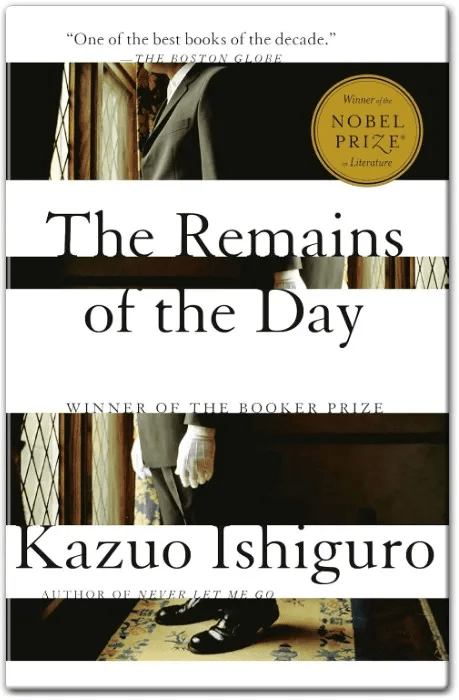
  • The Remains of the Day by Kazuo Ishiguro

    The year is drawing to a close very quick and I am doing lots of reading as one is want to do when it gets cold outside and the nights get longer. There’s no surprise then that this time of year brings with it a implicit attraction to some of the Russian classics; of which I’ve been taking my time getting through The Brothers Karamazov.

    However, when I finish one or two books from each part of the novel I put it down and dive into something else to give my brain time to catch up. Upon doing so this time I decided to pick up The Remains of the Day by Kazuo Ishiguro, which I’ve just finished.

    I tried reading Never Let Me Go in the past but it just could not hold my attention. However, The Remains of the Day was a profound and beautiful story. One I burned through over the course of three evenings.

    What kept me coming back was the sorrow I felt for the main character the whole time. As I read, I could see he had devoted so much of his life to his idea of order that he missed out on so much. Under the guise of dignity, he closes himself off to the beauty of the human experience.

    I suppose that is what happens to a lot of us. We will always have memories, but how we chose to spend our time determines how those memories return to us.

    Heartbreaking, wonderfully crafted, and engrossing. This was a 10 out of 10 read for me.

  • [sign on] November 25 2025

    The past two weeks have been a whirlwind of driving, delivering technical lectures and demos, and managing aggravated customers. Not uncommon in my line of work, but where this haul has been constant, the baseline is sporadic. This gave me lots of time behind a windshield and that means a lot of time to think. What did I learn, you might ask?

    I hate hotel rooms.

    The trips themselves are always disruptive to the normal flow of life, but I always manage to waste away the time in these rooms either working or doomscrolling.

    Currently reading: Hard Rain Falling, by Don Carpenter (US)

    I picked this one up after I finished part one of The Brother’s Karamazov as a quick palette cleanser. It is far from that. Hard Rain Falling is all at once existential and tragic. Some of these passages are jarring:

    He had always know he wanted freedom… and when he was ready, he escaped. That was all. Then he no longer wanted his freedom, because he had it.

    The freedom, our narrator later goes on to tell us, to manuever within the system. A system that will swallow you whole if you exercise your freedom. Because the system knows that, when left with their freedom, humans, most humans, become the worst versions of themselves. “You are free as long as you don’t do these things.”

    He had found their limits – they would not, could not, just take him out and shoot him, and they couldn’t let him run around loose, because he would not take any of their shit, so they had to lock him up and feed him… all because they had limits – limits that he did not have.

    The anti-hero’s lack of restraint forces the system to exercise restraint.

    Wrapped in grit and sordid on purpose, this book wrestles with some complex questions you’ll miss if you’re just reading for reading’s sake. Enjoying it.

    Currently listening:

    Currently working on: Getting everything done so I can be out of the office for 5 days.

    Happy Thanksgiving!

  • Chaos as a Crucible

    The singularity is what preceded the big bang. Just a hot, dense point in a dark vaccum that got so hot and so entropic that it exploded and the universe existed. A bunch of rocks and dust that evolved from the entropy into rocks that could sustain ecologies. That’s the current theory at least.

    From disorder came progress. From progress came disorder. And so on.

    It’s almost as if this cycle is the definition of in perpetuum. We exist in the cycle and, for a brief moment, we inherit some of its benefits and then we exit the chaos, hopefully having left enough of a mark on the mess to facilitate some progress.

    There’s so much economic uncertainly right now that is directly attributed to AI fatigue; particularly concern about the “AI bubble”. Many are absolutely convinced that there will be a burst. Others believe that the paradigm shift in our foundations of this Technological Revolution will result in long-term and lasting gains. Whether one or the other is true, there will certainly be progress that comes from this chaos.

    I think about this often: what if the human capital cost isn’t offset by the efficiency gains? Or, for that matter, what if it is? Wouldn’t there need to be policy that ensures basic sustenance for the current working class? Wouldn’t that policy need to extend to all who have been displaced? After all, if no one is working, what entitles one person to a universal basic income versus another, besides time spent out of the workforce?

    An AI burst would be catastrophic for the economy. A sustained period of prosperity would be catastrophic for the hoi polloi. One outcome impacts capital, and one doesn’t. And that is where I think the line of demarcation lies.

    Recent examples, like the Railway Mania of the 1840s and the Dot-com Bubble of the early 2000s are historical examples of new technologies (railways and the internet) driving economic bubbles due to excessive capital dumping and speculation. When both bubbles burst, they financially ruined not just wealthy investors, but also displaced professional and middle-class workers. The resulting policy responses, like the suspension of the Bank Charter Act in 1847 and the Sarbanes-Oxley Act of 2002 (SOX), were crucial for stabilizing global financial systems and allowing the displaced workforce to eventually rebuild within the actual utility of the surviving technology.

    The Industrial Revolution attracted massive capital investment and created long, sustained national prosperity. However, this success severely displaced skilled artisans and subjected the working class, including children, to brutal factory conditions and exploitation. Eventually the government had to do something to limit hours and enforce safer conditions, thereby regulating the technology and protecting workers.

    That’s where we are. An uncomfortable place to be, but not an unprecedented place to be. Don’t let the feeds convince you otherwise. The real question, or perhaps concern here is, will the progress be worth the entropy? If we go through the pain of an economic crisis and rebuilding, will the end justify the means?

    The answer to that question, as I’ve learned over the years in my career of helping build the technology that has led us to this moment, is: it depends.

  • [sign on] November 5 2025

    Currently listening:

    Currently reading: The Botanist by MW Craven

    Currently working on: Bash scripting, determining how to generate new work

    Lots of change in the political landscape of the US took place last night. A sharp reaction to the fatigue that the country’s been under over the last 10 years, to be sure. People are tired. They want to be left alone. They want the system to work for them. You can’t have both though, can you?

  • Station Identification

    Currently listening:


    Trump admin will partially fund November SNAP benefits

    Words can’t express how vile I think weaponizing food is. Both sides are guilty of this at the expense of “protecting their platform” or whatever weird justification they are using.

    Currently reading: The Botanist by MW Craven

    Locked-room mysteries are not something I’ve ever explored before. Although I believe this is the 8th book in this series, I’m having a blast with near-zero insight into character backstories. Quite an easy read so far but the real spotlight here belongs to the dialogue. The conversations between characters in this book feel natural, not too full of shitty banter, and drive the story forward in a meaningful way. Really enjoying it so far.

    credit: Brickmason (cover art for: 𝐧 𝐢 g h t c 𝐨 m m u t 𝐞)

  • [sign on] November 3rd 2025

    Real wealth is poverty adjusted to the law of Nature. — Epicurus

    Currently listening to: Selected Ambient Works 85-92 – Aphex Twin

  • [sign on] October 26 2025

    Currently watching: the Buffalo Bills at the Carolina Panthers

    Crisp and sunny out today. Perfect Sunday weather.

    On the road tomorrow, so send your podcast suggestions.